For almost everyone, the answer is Metro Line 11. It runs from the airport straight to Futian in about 30 minutes for roughly ¥7, with no change of train.
Two things most guides leave out. The station is called Airport, not Airport East, and those are different stations. And Line 11 has a business-class carriage. On most metro lines that would be a curiosity, but this is the line you ride with a suitcase, and at rush hour it can decide whether you sit or stand.
The Short Answer
| Option | To Futian | Cost | Best for |
|---|---|---|---|
| Line 11, standard carriage | ~30 min on the train | ~¥7 | Light luggage, outside rush hour |
| Line 11, business carriage | ~30 min on the train | ~¥21 | Big suitcases, rush hour, a long flight behind you |
| Ride-hailing | ~40 min, traffic permitting | Usually ¥80–100; app promotions can be lower | Groups, heavy luggage, late arrivals |
| Taxi | ~40 min, traffic permitting | about ¥95 by meter | No data or no app |
| Airport Express coach | Varies by route | ¥20–40 | After the last train |
Add 15 to 20 minutes to the metro times for the walk from arrivals to the platform.
Need Help After Landing?
Look for the international visitor service center on Level 1 of Terminal 3, beside the international arrivals exit. The government’s service-center guide lists round-the-clock help with payments, SIM cards, transport, tourism and immigration enquiries. Ask staff which services can be completed when you arrive; the information desk cannot guarantee that your card or payment app will be approved.
Step 1: Walk to Airport Station (Not Airport East)
From the arrivals hall, follow the Metro signs towards the Ground Transportation Centre. It takes 15 to 20 minutes on foot, and the signposting is clear the whole way.
The station you want is Airport (机场), on Line 11.
Airport East (机场东) is a different station. It is the end of Line 1, it is not in the terminal, and Line 11 does not stop there. The names are close enough that people mix them up on a map, and some older guides do too. If a route tells you to go to Airport East, check it again.
Step 2: Pay at the Gate
You have two options, and neither needs a local bank account.
A contactless foreign card. The metro takes Visa, Mastercard, American Express and JCB directly at the gate. Since 10 September 2026 all gate channels accept international cards with contactless and small-value PIN-free payments enabled, according to the operator’s announcement. This is one reader design:
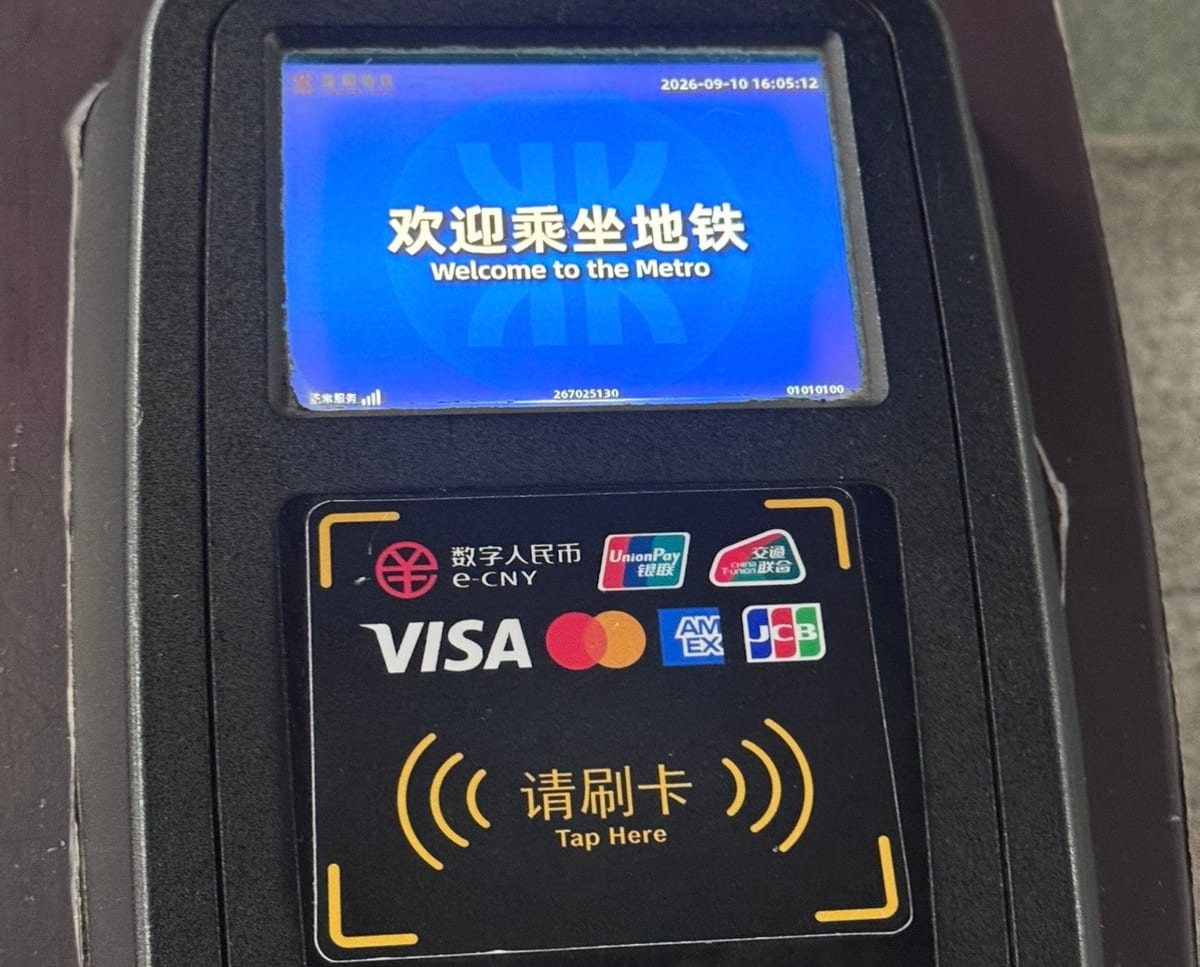
Photographed September 2026. Reader designs vary; the separate module in this photo is no longer a restriction on which gates accept foreign cards.
Alipay or WeChat Pay. Both apps have a metro QR code that you scan at the gate. If you have already set up Alipay with your foreign card, scan your metro ride code at the gate’s QR reader.
Either way, use the same card, device or ride code when you exit. The metro guide covers the rest, including the bag check at the entrance.
Step 3: Take the Train Towards Hongling South
On the platform, go for trains towards Hongling South (红岭南). That direction goes into the city. Bitou (碧头) is the other way, north-west towards Dongguan.
It helps to know that the airport is in the middle of the line, not at the end. Line 11 is one of the city's longest lines, 57.5 km from Bitou in the far north-west, through Songgang and Shajing, all the way to Hongling South. By the time a rush-hour train reaches the airport it is already carrying commuters, and the standard carriages usually have no seats left.
Where Line 11 takes you
| Going to | Get off at | Then |
|---|---|---|
| Futian CBD, Futian high-speed rail station | Futian 福田 | You're there |
| Nanshan, Houhai | Houhai 后海 | Lines 2 and 13 from here, including Line 13 to Shenzhen Bay Port |
| Huaqiangbei electronics market | Gangxia North 岗厦北 | Line 2 east, one stop to Huaqiangbei |
| Luohu, Lo Wu border crossing | Chegongmiao 车公庙 | Line 1 east to Luohu, the last stop |
| APEC 2026 venue area | Futian 福田 | Line 2 towards Chiwan, four stops to Xiangmi 香蜜 |
For the APEC venue, the station is Xiangmi (香蜜), not Xiangmihu (香蜜湖), which is on Line 1. The APEC accommodation guide explains why the difference matters.
The Business Carriage: What It Is and When It's Worth It
Line 11 was the first metro line in mainland China with a business class. Cars 7 and 8 are fitted with 2+2 padded seats, close to what you get on a high-speed train, with space under the seats for a small bag. Standard carriages have the usual metro benches along the walls.
How much
Roughly three times the standard fare: about ¥21 from the airport to Futian, against about ¥7 in a standard carriage. Strictly, you pay the normal fare plus twice the Line 11 part of your journey, so if you change to another line afterwards, the extra only applies to your time on Line 11.
How to board
- Tap in at the normal gate as usual.
- On the platform, look for a section fenced off with barriers, with a single opening, a validator and usually a member of staff. The business carriages stop at the Bitou end of the train, which is the back when you're heading into the city.
- Tap again at the validator, with the same card or the same QR code you entered with. International cards have worked here since 30 June 2026.
- Board cars 7 or 8.
If you walk into the business carriage without the second tap, you have not been upgraded. You are travelling without the right ticket.
Is it worth it?
Most of the time, I take it. Line 11 is crowded. Gangxia North, where it meets three other lines, is one of the busiest stations in the city. If you are carrying a large suitcase, I would take business class without thinking twice.
It does not guarantee a seat, though. One weekday this month even the business carriages were standing-room only, and I waited for the next train rather than stand the whole way. It is still far more space than the standard carriages at the same hour. Just don't assume the higher fare buys you a seat.
If you are travelling light and outside rush hour, the standard carriage is perfectly fine.
Taxi and Ride-Hailing
Both leave from the Ground Transportation Centre and run 24 hours.
- Taxis: second floor, east side, outside Gate 13. Metered, and about ¥95 to Futian by the shortest route. Expect more at night.
- Ride-hailing: Zone A is outside Gate 15 on the ground floor, south side. Zone B is indoors on the ground floor. The app picks the zone, and it may warn you the pickup is a fair walk from where you are. Believe it.
Ride-hailing prices vary more than you'd expect between apps. On a weekday afternoon this September, a Chinese map app quoted ¥39–61 for an economy car from the airport to Futian, with a promotion applied and a possible ¥13 expressway toll added separately. The journey was estimated at about 40 minutes. International apps don't always show the same prices. When I take a car from the airport to Futian myself, it usually comes to about ¥80–100, so plan on that and treat anything cheaper as a promotion. Setting up the app is covered in my DiDi guide.
For ride-hailing, keep an internet connection while booking and finding your driver. Check your roaming coverage or set up a travel eSIM before you fly. A metered taxi does not require an app or mobile data.
If You Want to Arrange a Pickup Before Flying
Check Kiwitaxi's Shenzhen airport-to-city transfer options if you prefer to arrange a private pickup in advance. Enter your hotel address, arrival date and passenger count to get the quote for your journey; the generic Shenzhen route is not a quote for every hotel. Check flight-delay handling, included waiting time, luggage capacity and cancellation terms before paying. Complete the booking on the website.
This is usually a more expensive convenience option than the metro or a local taxi. I have not personally used Kiwitaxi. The link is an affiliate link: I may earn a commission at no extra cost to you.
Arriving Late
The last Line 11 train into the city leaves the airport at about 00:02. The first train in the morning leaves shortly before 6am. Timings shift slightly between weekdays and weekends, so check the board at the station if you're cutting it close.
After the last train you have three options:
- Airport Express coaches run late-night routes to Futian, Nanshan, Longhua, Longgang and other districts until the last flight has landed, at ¥20–40 depending on the route. Buy tickets at the counter by Gate 17 of the Ground Transportation Centre, or scan the QR code there.
- Taxis run all night from Gate 13.
- Ride-hailing works all night too, but the airport itself warns that late-night arrival peaks can mean a queue for a car.
With luggage after midnight, a taxi or ride-hailing car is what most people end up taking. The coach is the cheaper option if you're travelling light and your hotel is near one of its stops.
Staying Overnight Between Flights?
An 8pm landing and a 3pm departure the next day do not give you nineteen hours in the city. Allow for arrival formalities, baggage, both airport journeys and your airline’s check-in requirements. Confirm your entry permission before planning to leave the international transit area; the 240-hour transit guide explains the route and passport conditions.
- Stay near the airport if sleep is the priority, you have heavy bags, or arrival formalities leave little usable time. Confirm late check-in and the return journey with your accommodation.
- Go into the city if you have enough time for both journeys and a proper night’s sleep. Pick one area, check the last train or budget for a car, and avoid adding several districts to a short stop. Compare hotel areas and choose one evening outing.
Resting at the terminal
A September 2026 Shenzhen Daily report published on the city government’s website lists a free reclining-chair rest area beside ride-hailing Area B, on Level 1 of T3’s Ground Transportation Centre, open 10pm–6am. It says passengers register with a valid identity document and proof of travel. Ask airport staff about access and space before relying on it. This is a shared rest area, and a seat is not guaranteed.
The same report lists paid Yunxiaoxi Rest Area (云小息休息区) sleeping pods in T3’s Level 2 east reception hall. Check current availability and booking terms rather than relying on a quoted historical price. Both facilities require access to the public terminal area; if you are staying airside, ask the airline or airport about options available without entering mainland China.
Common Questions
Is Line 11 the Shenzhen Airport Express? Yes. It was originally called the Airport Line, and it's the fastest rail link from Bao'an Airport to Futian and Nanshan.
How much is the metro from Shenzhen Airport to Futian? About ¥7 in a standard carriage, or about ¥21 in the business carriage.
Can I use my Visa or Mastercard on the Shenzhen Metro? Yes. From 10 September 2026 all gate channels support international contactless cards with small-value PIN-free payments enabled. American Express and JCB work too. Your card also works at the business-carriage validator on Line 11.
What time is the last metro from Shenzhen Airport? About 00:02, towards Hongling South. After that, take an Airport Express coach, a taxi or a ride-hailing car.
What's the difference between Airport and Airport East stations? Airport (机场) is on Line 11, at the terminal. Airport East (机场东) is the end of Line 1, and it's not the one you want coming off a flight.
How long does it take to get from Shenzhen Airport to the city centre? About 30 minutes on the train to Futian, plus 15 to 20 minutes to walk from arrivals to the platform. By car, allow around 40 minutes outside rush hour.