Huaqiangbei (华强北) is the largest electronics wholesale market in the world. A few square kilometers of Shenzhen contain thousands of stalls selling components, gadgets, phone parts, cables, tools, and consumer electronics at prices you won't find anywhere else.
Most online guides describe it vaguely. This one is written by someone who grew up in Shenzhen and has been going there for years.
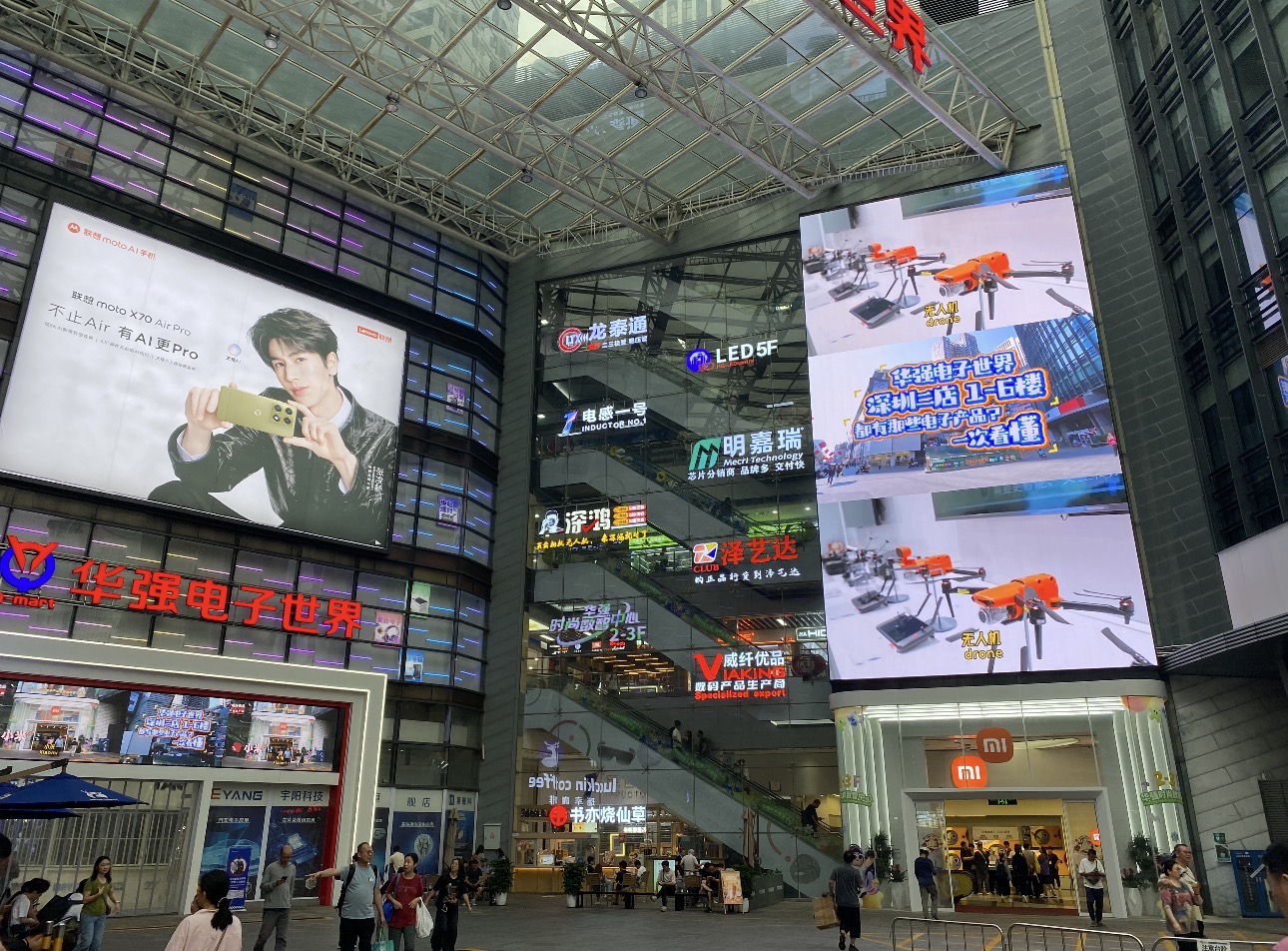
Why Foreigners Make the Trip
Noted August 2026: there are visibly more foreign visitors here than there were a year ago. Expect the district to feel busier with non-Chinese shoppers than older guides describe, and expect sellers to be correspondingly practised at quoting them.
Huaqiangbei is one of the few places on earth where the way the world's electronics actually get made becomes visible. Every gadget you've ever owned probably touched this district at some point, through a component sourced here, a prototype tested here, or a factory supplier that runs a stall on one of these floors.
For tech enthusiasts and makers: This is a pilgrimage destination. You can walk a single building and find every Arduino clone, every ESP32 variant, every obscure sensor you'd normally spend weeks hunting on AliExpress, in person, priced by weight, negotiated directly with the person who handles them every day.
For curious travelers: Even if you don't buy anything, Huaqiangbei is a window into how modern consumer tech is made and distributed. The sheer scale, thousands of stalls, millions of parts, is genuinely unlike anything else. Most visitors who come "just to look" end up buying something.
For bargain hunters: Accessories that cost $30–50 in Western retail cost ¥10–30 here. USB cables, earbuds, power banks, cases, you'll spend more on food than on a bag full of electronics.
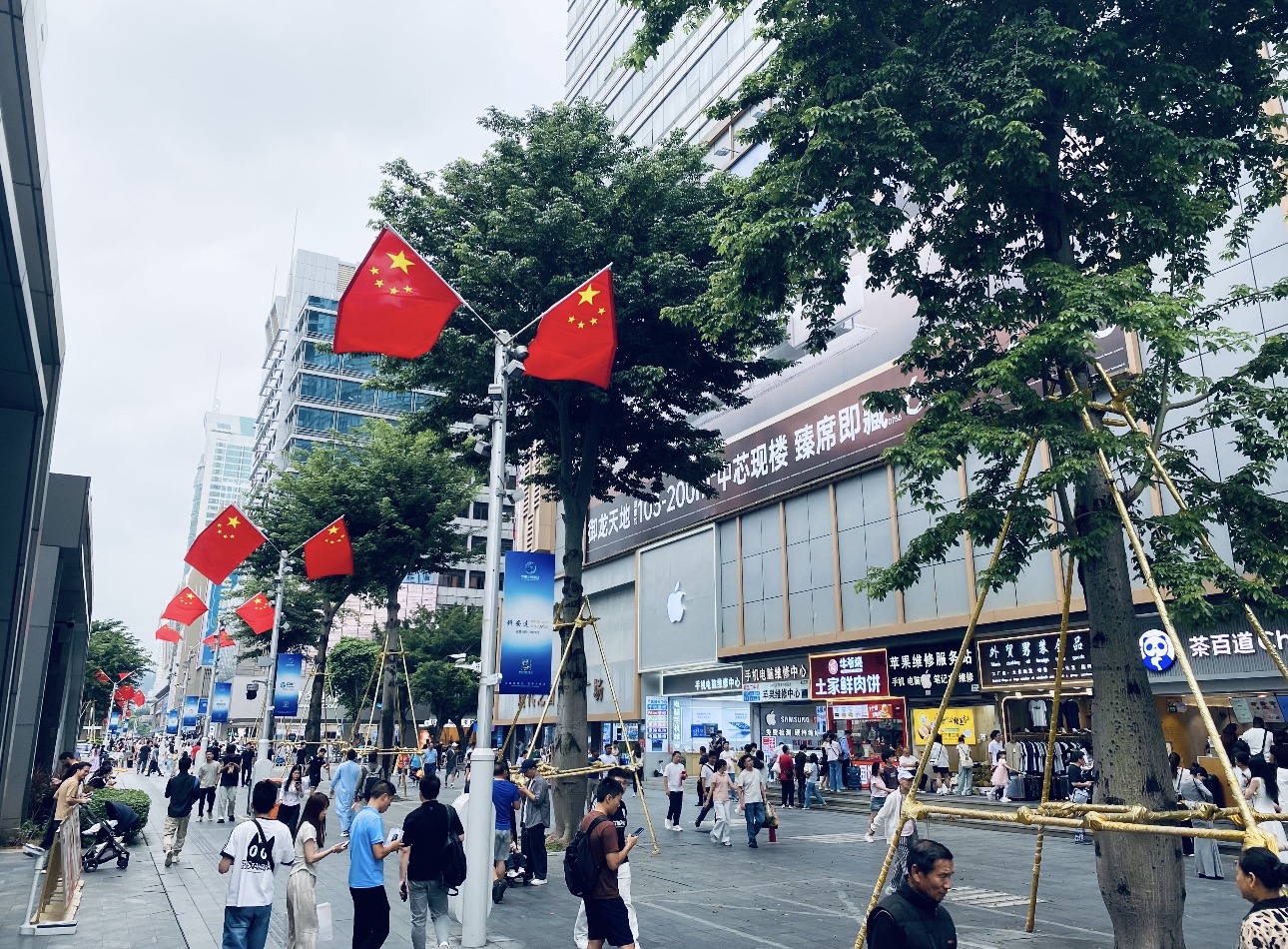
The Evening Scene
Huaqiangbei doesn't shut down when the stalls close. After 8pm, the pedestrian street shifts into what locals call a geek night market, independent makers selling homemade robots, modified game controllers, and custom electronics builds on folding tables. It's informal, unpredictable, and genuinely interesting.
The LED billboard corridor transforms into something closer to an open-air light installation at night. It's a different atmosphere from the daytime wholesale hustle, more relaxed, more creative, worth seeing even if you visited during the day.
What Huaqiangbei Actually Is
It's not one market, it's an entire district of interconnected buildings, each specializing in different products. The ground floor of each building often has retail stalls; upper floors are more wholesale-oriented.
The area is centered around Huaqiangbei Road (华强北路) and the nearby streets. The Huaqiangbei metro station (Lines 1 and 7) drops you right in the middle.
The Key Buildings
The district is not one market, it is dozens of buildings, and walking into the wrong one wastes an afternoon. Start here, then read the detail below.
| Building | Go here for | Skip if |
|---|---|---|
| SEG Electronics Market 赛格电子市场 | Components, tools, maker parts, repair counters | You want finished consumer products |
| Mingtong Digital City 明通数码城 | Skip it. Guides still calling this a phone market are out of date | |
| Yuanwang Digital City 远望数码城 | Security cameras, NVRs, networking gear | You are not shopping for hardware infrastructure |
| Huaqiang Electronic World 华强电子世界 | Finished gadgets: smartwatches, earbuds, speakers, action cameras | You need individual components |
If you only have two hours, Huaqiang Electronic World covers what most visitors actually came for. SEG is the one worth the trip if you build things.
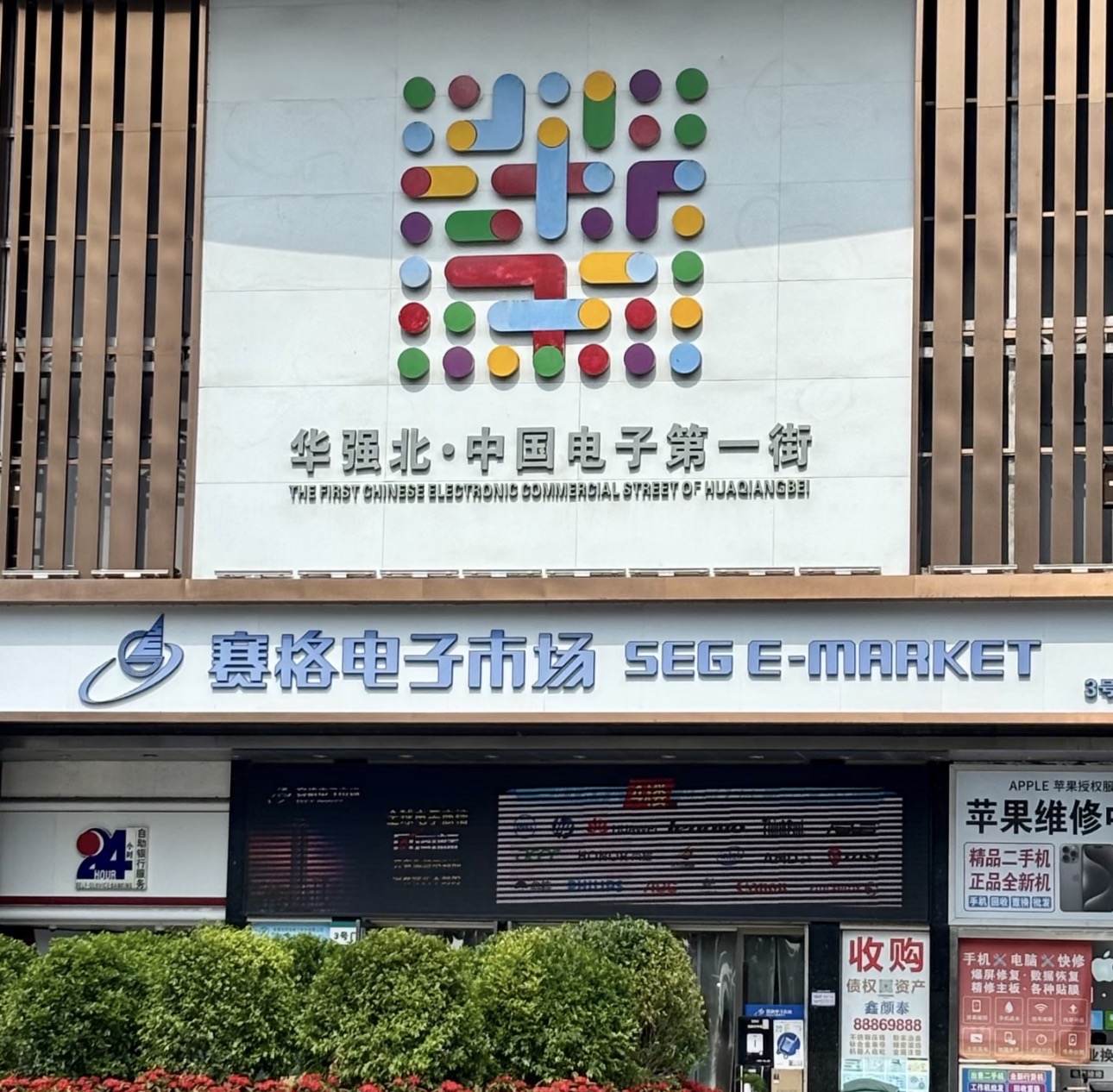
SEG Electronics Market (赛格电子市场)
The most famous building and the best place to start. 8 floors of components, modules, development boards, cables, tools, and accessories. You'll find:
- Arduino, Raspberry Pi, and Chinese equivalents
- LED components, sensors, motors
- Cables (USB-A, USB-C, Lightning, proprietary) in bulk
- Phone repair parts
- Electronic tools (soldering stations, multimeters)
Who it's for: Makers, hardware engineers, people sourcing components, phone repair shops. Less useful if you're looking for finished consumer products.
Prices: Component prices are extremely low. A USB-C cable that costs $10 at retail might be ¥5–15 here wholesale.
Mingtong Digital City (明通数码城)
Do not go here expecting a phone market. It has not been one for the better part of a decade, and a surprising number of English guides still say it is.
Mingtong opened as a phone and accessories market and was, at one point, one of the largest in Southeast Asia. In March 2017 it converted to imported cosmetics, renamed itself Mingtong Cosmetics Market, and by 2019 the changeover was complete. It boomed around 2020–2021, when the pandemic cut off overseas duty-free shopping and buyers came here instead.
Then it went the other way. After a regulatory crackdown in 2021 the market went quiet, counterfeit stock became the defining problem, and by September 2023 trade press was reporting stalls abandoned and floors emptying out.
What that means for you: it is not a shopping destination for a visitor any more, in either category. Skip it unless you have a specific reason, and treat any guide that still lists it as a phone market as evidence that guide has not been updated in years.
On second-hand phones generally — they are sold across the district, not in one building. The risks are real: refurbished internals, iCloud locks, faked battery health. Unless you can verify a device on the spot, or have someone with you who can, this is the one category where a visitor is most likely to lose money.
Yuanwang Digital City (远望数码城)
Focus: Security cameras, surveillance systems, networking equipment.
Less interesting for most tourists, but if you need IP cameras, NVRs, or network switches at wholesale prices, this is the place.
Huaqiang Electronic World (华强电子世界)
Best for finished consumer gadgets, smartwatches, earbuds, portable speakers, action cameras.
Many of these are unbranded Chinese products that are functionally similar to name brands at 20–40% of the price. Quality varies, see the buying tips below.
What's Actually Worth Buying
High confidence purchases (easy for visitors):
- USB cables and charging accessories, buy in bulk, quality is fine, prices are excellent
- Power banks, check capacity specs on a battery tester app before buying
- Earbuds and basic headphones, unbranded earbuds at ¥30–80 often sound comparable to $30 retail products
- Screen protectors and phone cases, stock up
- Small electronic tools, especially useful for makers (soldering irons, wire strippers)
- Arduino/Raspberry Pi clones, completely legitimate, commonly used by engineers worldwide
Requires more caution:
- Smartwatches, cheap ones often have poor battery life; test with the seller before buying
- Action cameras, some are genuine alternatives to GoPro; others are barely functional. Ask to see video footage.
- Laptop chargers, quality varies widely; confirm voltage and amperage match your device
Avoid unless you know what you're doing:
- Second-hand iPhones, high risk of fakes, locked devices, or replaced internals
- "Branded" items at suspiciously low prices, counterfeit risk is real here
What I actually buy here, for whatever it is worth as a signal: charging cables, power banks, earbuds including AirPods, small Bluetooth speakers — I bought a compact Marshall here — massage guns, Apple Watch straps and cases, phone cases, and the soft-toy stuff that periodically takes over the city, Labubu included. Genuinely branded cases turn up too. Casetify, which is a fairly expensive brand online, sells here for a few tens of yuan.
The pattern is that accessories and small consumer goods are where this place is unbeatable, and high-value electronics are where the risk lives. In years of buying here I have rarely been burned, but I also compare three stalls before paying for anything.
Can I Get Something Repaired in Huaqiangbei?
This is the part most visitor guides miss, and it is arguably more useful to a traveller than the shopping.
Huaqiangbei repairs things. Phones, laptops, tablets, cameras, small appliances — if it has a circuit board in it, someone in these buildings fixes it, usually while you wait and usually for a fraction of what an official service centre charges. This is what the district is for locally. People come here when something breaks, not only when they want to buy.
For a visitor, that matters more than it sounds. If your phone screen cracks in Shenzhen, you do not have an appointment at a service centre, you may not have the language, and you may be flying out in three days. Huaqiangbei will have it back to you the same afternoon.
The same rule applies as with buying: ask several places. Repair quotes vary a lot between shops for identical work, and the first quote is not the market rate — it is an opening number. Walk to two or three more counters and ask the same question before agreeing to anything.
Will I Be Quoted a Higher Price as a Foreigner?
Yes, routinely, and it is worth understanding exactly how it works before you go.
A phone case that a local would be quoted ¥30–40 is regularly quoted at ¥70–100 to a foreign customer. Not because the seller is unusually dishonest — Huaqiangbei runs on negotiation, and the opening number is always a test — but because a visitor who has just arrived in China has no instinct for what a yuan is worth. ¥100 converts to a number that sounds reasonable in dollars or euros, so it does not trigger the reaction it would in a local. Sellers know this.
So the practical effect is that you start the negotiation from a much worse position than a local does, without knowing it.
Three things fix most of it:
- Know the yuan, not the conversion. Decide what an item is worth in yuan before you ask. If you are converting in your head at the stall, you have already lost the anchor.
- Ask three stalls before buying anything. The same item usually has several sellers in the same building. The third quote tells you what the real range is — and this single habit does more than any negotiating technique.
- If you have a local friend, bring them. Not for translation, which your phone handles. For the price you get quoted in the first place.
I buy here regularly and rarely get burned, but that is not skill — it is that I already know roughly what things cost. That knowledge is the thing a first-time visitor is missing, and it is the whole gap.
How to Bargain
Prices in Huaqiangbei are rarely fixed, especially in the stall markets. A few rules:
1. Start at 40–60% of the asking price. If they ask ¥200, offer ¥80–100. The final price will land somewhere in between. Don't feel embarrassed, this is the expected process.
2. Walk away if needed. Sellers will often call you back with a better price. If they don't, the price was probably already close to their floor.
3. Buy multiple items from the same seller. "How much for 5?" almost always unlocks a discount. Even if you only need 2, buying 3–5 will get you a better per-unit price.
4. Use Google Translate or point to your phone. Most sellers will type numbers into their phone calculator rather than speak a price. This removes the language barrier for negotiation.
5. Don't show your first reaction to a price. If you immediately look excited, the bargaining position weakens. Neutral face, check the item slowly, then counter.
The line locals actually use is simply "too expensive — the other shop sells it cheaper" (太贵了,别人家卖的比你这便宜). It works because it is usually true, and because the seller knows you can walk thirty seconds to check. There is no clever technique underneath it. Walk a few laps, ask a few stalls, and never treat the first stall as your only option.
Getting There and Getting Around
Metro: Huaqiangbei station (华强北站) on Line 2 and Line 7. This is the one you want.
Two stations, similar names. There is also Huaqiang Road station (华强路站) on Line 1, which is a different station. It is still walkable to the district, but it is not the one that drops you in the middle of it. Locals mix these up too. If your app says Line 1, you are heading for Huaqiang Road, not Huaqiangbei.
Follow the in-station signs for the market rather than a specific exit letter — the exits get renumbered during works, and the buildings are signposted once you are up on the street. If you haven't used the Shenzhen metro yet, our metro guide covers paying with your phone instead of queueing at a ticket machine.
Inside the buildings: Very crowded, especially on weekdays when wholesale buyers are active. Weekends are slightly less congested. Bring a bag, you'll want your hands free.
Payment: Most stalls accept WeChat Pay and Alipay. Cash (RMB) is always accepted. Credit/debit cards are not widely accepted in individual stalls. Set up a payment app with your foreign card before you come, since this is exactly the kind of place where it matters — see the Alipay and WeChat Pay setup guide.
Plan 2–3 hours minimum if you want to explore properly. Serious buyers spend all day.
Practical Tips
Go on a weekday. Weekends bring more retail tourists and prices may be slightly higher. Weekdays are when the wholesale buyers come and you'll see the market at full operation.
Bring a portable power bank or charger. You'll be on your phone constantly (translating, searching reference prices, calculating).
Check prices before you go. Know what you want to buy and what it costs at retail. This gives you a reference point for negotiation and helps you recognize a genuine deal.
Don't buy everything at the first stall. Walk around and compare. The same item often has 3–5 sellers in the same building at different prices.
Bring cash as backup. Even with Alipay, some deep-in-the-building stalls are cash-only.
Getting from the Border to Huaqiangbei
All three main arrival points are 15–30 minutes away, with at most one change.
| Arriving from | Route | Time | Fare |
|---|---|---|---|
| Lo Wu / Luohu crossing | Line 1 from Luohu → Huaqiang Road. No change | ~20 min | — |
| Futian checkpoint | Line 4 → change at Civic Center (市民中心) → Line 2 → Huaqiangbei | ~14 min | ¥4 |
| Shenzhen North (high-speed rail) | Line 4 → change at Civic Center → Line 2 → Huaqiangbei | ~23 min | ¥5 |
Note what the Luohu route does: Line 1 does not reach Huaqiangbei station. It reaches Huaqiang Road, which is a different station about 400m away. That is fine — you walk the last stretch — but it is why the "which station" confusion above matters. From Futian and Shenzhen North, changing at Civic Center onto Line 2 puts you at Huaqiangbei itself.
If you would rather not change trains at all, Line 4 → Convention & Exhibition Center (会展中心) → Line 1 → Huaqiang Road also works from both, and takes a few minutes longer.
New to shopping here? The Shenzhen shopping guide covers how bargaining works, how to pay at a stall, and why the shops at the border crossing are the worst value in the city.
Coming over from Hong Kong for the day? The Hong Kong to Shenzhen guide compares every crossing, and Futian Checkpoint is the one that puts you closest to Huaqiangbei.
Flying in from further away and unsure whether you need a visa at all? If your passport is not on China's visa-free list, the 240-hour visa-free transit gives you ten days, which is far more than a Huaqiangbei trip needs.
Where to Eat Nearby
Don't leave the area hungry.
An older recommendation removed. This guide used to point at Mingxiang (明香), a 33-year-old local institution on Huafa North Road. It closed in September 2025. If you have seen it recommended elsewhere, that advice is out of date — a lot of Huaqiangbei guides have not caught up.
The food court floors in the larger malls around the district (look for the basement or top-floor food courts) have Cantonese roast meat, noodle shops, and congee at ¥15–40 a dish. Better value than anything at street level aimed at visitors.